Last updated 2026-09-28.
A convenient home charger supports the way you actually use the car. It is not simply the unit with the largest number on its brochure. A vehicle that spends most nights in its usual bay presents a different problem from one that returns late, leaves early or shares a driveway. Starting with that routine makes an equipment discussion more useful and helps you recognise whether a proposed improvement would change everyday life.
Request a callbackBegin with the energy you want to replace
A charging discussion becomes clearer when you distinguish a routine top-up from a complete refill. Think about the driving you want home charging to support, then use vehicle information to describe the energy that needs replacing. There is no universal daily figure suitable for every Brisbane household. Different vehicles, journeys and habits make a standard assumption less useful than your own experience.
The Australian Government’s home charging guidance explains estimating time from energy and charging rate. Its figures are general orientation, not a promise for your car. The home installation guide connects the equipment question with the parking position and fixed route at the actual property.
Parking time can matter more than a headline rate
A car parked for a long evening has a different charging window from one used throughout the day. The available window is the period when the vehicle could genuinely remain connected, not every hour it happens to be at home. A driveway that another household member needs to cross or a garage used for storage can make that distinction important.
The charging-time calculator lets you compare your own energy, sustained-power and parking-window figures. It is ideal unit arithmetic, with losses and interruptions excluded. A target that fits the arithmetic still needs an assessed electrical arrangement. A target that does not fit is a useful reason to discuss the routine rather than immediately buying higher-rated equipment.
The vehicle is part of the charging limit
A wall unit’s capability is only one part of the proposed arrangement. The vehicle also has charging requirements and limits. Paying for a product with a larger advertised output may not provide the benefit you expect if another part of the arrangement limits the sustained rate.
Use the vehicle model and manufacturer’s information to anchor the conversation. An electrician can then consider the selected charger alongside the circuit and available supply. Energex’s home charging options explain why different connection arrangements exist. The three-phase guide is relevant when the question concerns supply capability, not simply a preference for the highest product rating.
Make the charging position easy to live with
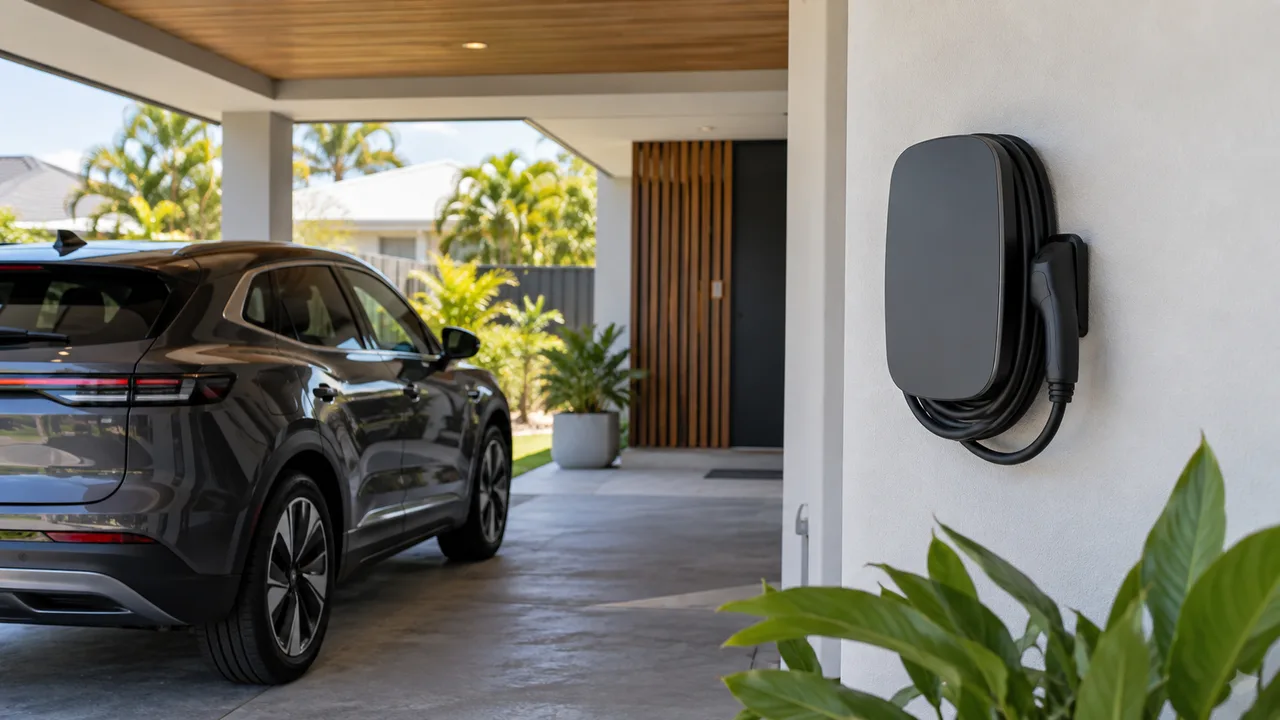
A technically possible position can still be awkward. The vehicle inlet, direction of parking and everyday movement around the space affect whether the cable will be convenient. A mounting point that forces a lead across a normal doorway may create a recurring inconvenience that a different position avoids.
Describe the parking space as it is used, rather than as an empty rectangle on a plan. Mention another vehicle, a gate, a pedestrian route or an outdoor position if it changes the practical outcome. This is not a request to design the installation yourself. It helps the contractor understand what a usable finished arrangement should achieve before choosing the permanent equipment position.
Prepare the parking and equipment detailsA second vehicle changes the household question
If another vehicle may need charging, discuss that possibility separately from the current request. Two chargers, a shared charging routine and one unit serving different vehicles are not identical projects. The household’s expected use matters as much as the number of vehicles.
A first installation should have a clear present scope. A possible future addition can be recorded as a separate preference rather than silently treated as included capability. That gives you a fair basis for comparing the price and value of any proposed allowance for later work. It also avoids treating today’s circuit or equipment setting as permission for a different future arrangement.
Other demand may affect the useful charging window
Cooking, cooling and other household loads can overlap with the time you want to charge. The relevant assessment is not a generic picture of an average home. It is the proposed charger and the existing installation at your property.
The demand-management guide explains why a control may change charging behaviour when other demand rises. Ask what that behaviour means for the driving routine you described. A proposal that reduces the nominal rate at some times may still fit a long parking window, while the same behaviour could matter more for a shorter one. The useful outcome is an understandable match between the arrangement and the routine.
A shared bay adds a separate dependency
An apartment resident may have a predictable driving week without having authority to alter the intended bay or route. Parking rights, access to electrical rooms and permission for common surfaces need their own answer. Electrical feasibility does not settle those decisions.
The apartment charging guide separates shared-property questions from electrical design. The Brisbane City locality guide starts with the resident’s actual parking right. A building-approved route and a workable electricity arrangement give the charging discussion a more useful starting point than equipment ownership alone.
Seek a proposal for your outcome
The written proposal should explain the arrangement it covers, including the equipment, position, fixed route and any supply or board work. Ask how the proposed operating setting fits the energy target and parking window, and which assumptions would need reconsideration if the vehicle or routine changes.
A home enquiry can begin before those technical answers are known. Explain the routine and the uncertainty in plain language. Any available contractor who accepts the project must establish the actual scope, price and conditions. Sending an enquiry does not confirm a provider, appointment or installation, but clear property information gives a later conversation something practical to work with.
Request a callback