
Last updated 2026-09-28.
An apartment charging request becomes easier to consider when it explains the property arrangement as well as the equipment. A resident may be willing to pay for a unit yet remain unable to authorise the wall, route or electricity supply it would use. A useful proposal makes those dependencies visible instead of treating a charger purchase as the start of installation.
Request a callbackBegin with the actual bay
An allocated bay, an exclusive-use arrangement and a visitor space are not the same starting point. Establish which space belongs with the apartment and who can make decisions about it. A vehicle owner may use a space without controlling every surface or service beside it.
Queensland’s body-corporate EV resource provides general planning information for community titles schemes. The applicable building documents and decision-makers still matter. The apartment service guide separates parking and property authority from electrical feasibility, so a provisional route is not mistaken for an approved one.
Explain what would change in common space
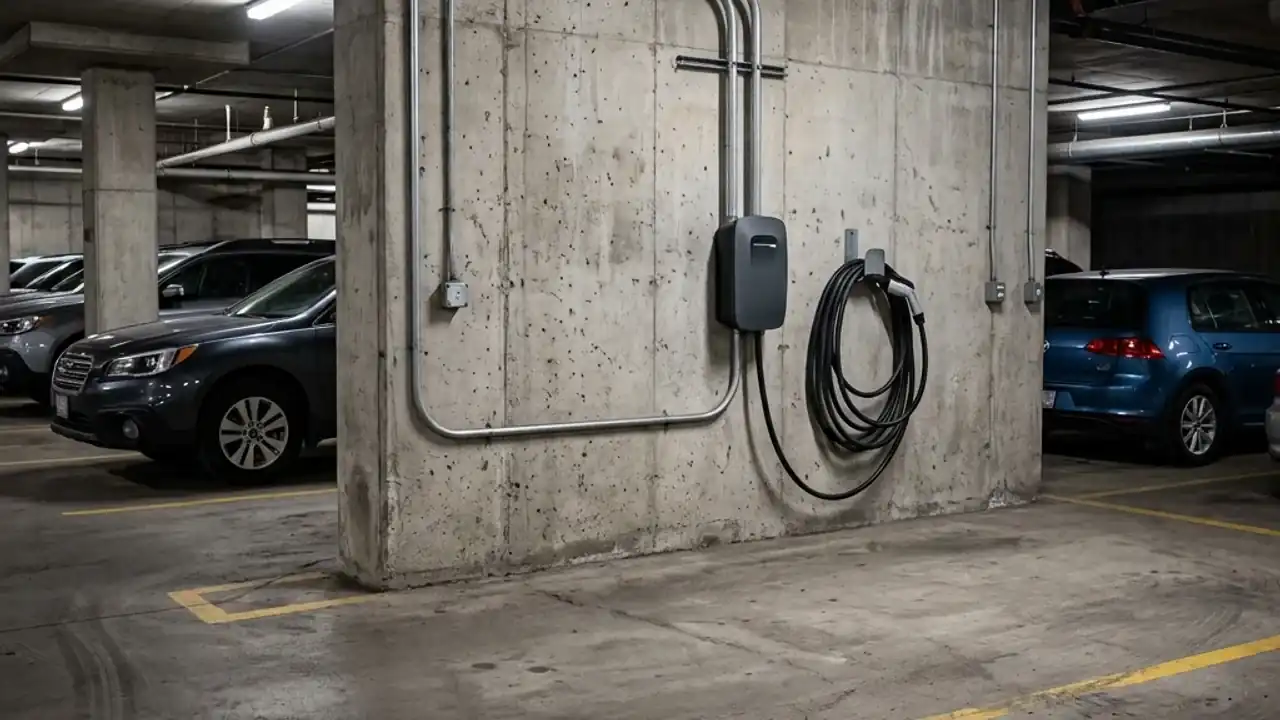
A small wall unit can have a route extending beyond the resident’s own space. Ceilings, shared walls, access passages and electrical rooms may involve common property. The useful question is which parts of the proposal would affect that property and who can authorise those changes.
The Queensland body-corporate information explains the general role of by-laws in common-property management. It does not determine approval for a particular charger. Describe the intended alteration clearly enough for the relevant building decision-maker to consider it, while leaving electrical specifications to the contractor who assesses the premises.
Keep one resident’s request separate from a wider scheme
A personal charger for one bay and a building-wide charging programme have different goals. A personal proposal needs a permitted route and an understandable electricity arrangement. A wider proposal also raises questions about future users, shared equipment and how the building would manage expansion.
Combining the two without saying so can make a modest request appear to commit owners to a much larger project. It can also leave the first applicant paying for work whose intended benefit extends beyond that bay. The proposal should identify whether it covers one installation, a shared service or an initial stage of something larger.
Electricity attribution needs a practical answer
The person charging the vehicle and the person receiving the electricity bill may not be the same. The existing supply and metering arrangement therefore matter before household tariff assumptions are applied to a common garage. An equipment brochure cannot settle who will pay for energy at that building.
A building contact and licensed contractor can explain which arrangements are actually available. Energex’s charging guidance describes network options, not a universal billing arrangement for apartments. The South Brisbane guide helps separate the proposed charger from the building’s electricity account.
Prepare the building and equipment informationDay-to-day access deserves a place in the proposal
An installation is useful only if the resident can operate it within ordinary garage access and parking rules. If a product relies on an account, app or access permission, discuss what happens when the vehicle, tenant or owner changes. A charger that works during an installation visit may still need a clearer ongoing arrangement.
This is a customer and governance question as well as an equipment one. The proposal can identify who controls access, who can disable it and who would handle a future change. Those details help the building understand the ongoing effect of the equipment instead of considering only its size and purchase cost.
Approval and electrical design are separate decisions
A building can permit a proposed route without establishing that it is electrically suitable. Conversely, a contractor can identify a technically workable route without having authority to alter it. Both answers are needed for a real installation.
A useful preliminary assessment identifies the relevant dependency and its scope. It should not describe a possible path as already approved or assume that nearby equipment provides available capacity. The switchboard and capacity guide explains why observations at the actual installation matter. Where a proposal includes network steps, the contractor should identify which current requirement applies.
Make responsibilities understandable
The owners considering a proposal need to know who would own the equipment, arrange access and deal with maintenance or later removal. The resident needs to know which costs belong to the personal installation and which decisions remain with the building.
Clear responsibilities make a proposal easier to evaluate without claiming that every scheme needs the same legal arrangement. Ask the relevant decision-maker which documentation is needed for this building. If legal, insurance or governance questions remain unresolved, obtain appropriate advice rather than relying on a general charging page to decide them.
A bigger charger is not the whole benefit
A resident may principally want the convenience of arriving at a reliable charging space. That outcome depends on access and the vehicle’s routine, not only on a product’s maximum rate. A stable authorised bay can be more useful than a higher-capacity unit that cannot be fitted where the vehicle normally stays.
The charging-time calculator can compare your own energy and parking-window figures. It does not test the building’s electrical capacity. The Fortitude Valley guide discusses a lasting bay and equipment arrangement, including the distinction between a personal addition and building infrastructure.
A focused enquiry gives the proposal a starting point
Describe the parking right, the normal vehicle position and what the building contact already knows. Mention whether the request is for one resident or a wider project. It is reasonable for some details to remain unknown at the first conversation. What matters is avoiding an assumption that those details are already resolved.
The contractor who accepts work must establish the actual electrical scope, while the relevant property parties determine permission. This website does not approve an apartment charger or guarantee a provider response. A clear enquiry helps keep those roles distinct and gives a possible next conversation a practical problem to address.
Request a callback