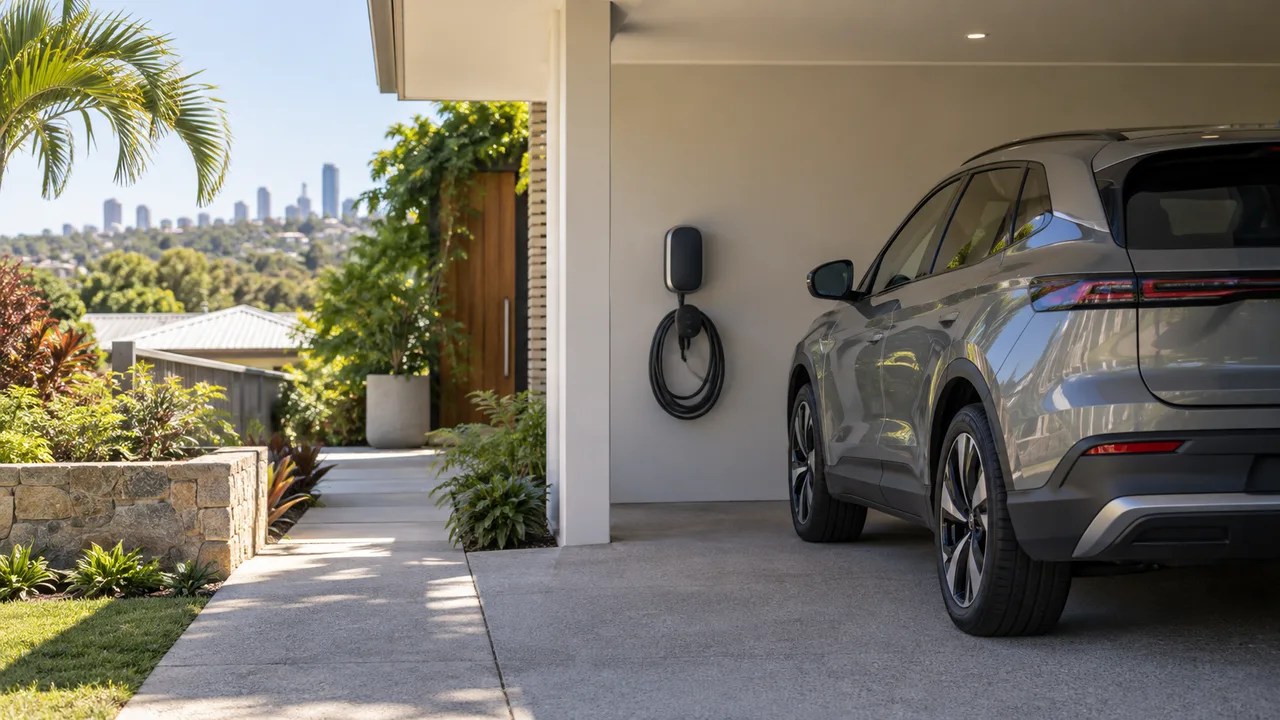
EV Charger Installation in Sunnybank
Sunnybank households can make EV charging decisions clearer by recording when the vehicle will charge as well as where it will park. The proposed equipment position, household demand and electrical route all matter before a fixed charging arrangement is selected.
How to frame an EV charger assessment
A Sunnybank charging brief should pair the vehicle's normal parking position with the household's likely charging period. Note the proposed charger location, the available route back to the board and other substantial loads that commonly run at that time. This allows the assessment to concentrate on the proposed circuit and demand pattern rather than on a generic claim about charging speed or the suitability of an existing outlet.
Electrical design decisions
Equipment choice follows the assessment, not the other way around. The selected unit's instructions, fixed mounting position, cable protection and switchboard arrangement need to align. If solar, batteries or an unusual charging schedule are part of the decision, include that context so the contractor can explain what needs to be checked. Keep tariff choices, electrical scope and distributor processes as separate questions rather than assuming one answer settles all three.
Local context for Sunnybank
Sunnybank's 2021 Census data recorded 20 flats or apartments, only 0.7% of occupied private dwellings. Council historical material describes the locality's shift from a rural community into housing estates in the late 1950s and 1960s. Together, those facts support asking about the actual driveway, garage or carport arrangement without treating any one form as typical. This is useful development context, not evidence of an individual property's age, parking form or electrical condition. A charging enquiry is strongest when it records the actual board, vehicle position and route. Any circuit, load-management or switchboard decision follows a property-specific electrical assessment.
Prepare a useful installation brief
For Sunnybank households, note when charging is expected to occur and which larger electrical loads may run at the same time. Pair that with photos of the board exterior, parking position and proposed charger wall. This gives the electrical assessment a realistic demand and routing picture. It avoids treating an existing outlet, a solar system or a charger advertisement as proof that a particular charging arrangement is already suitable.
Use the charging window and other household loads to guide the questions asked at assessment. If a load-management option, solar coordination or board work is mentioned, ask what site evidence supports it. The value is a scope that links the proposed equipment to the actual demand pattern rather than a broad promise about speed or savings.
Use the assessment to turn the household routine into a clear electrical question. Explain when the vehicle is expected to charge, whether large appliances commonly run then, and whether solar or battery settings are relevant to that discussion. The contractor can use those facts with the board and charger specification to identify what needs review. This is more useful than relying on a broad claim about savings, speed or an assumed upgrade, because it begins with the way the premises will actually be used.
Sunnybank households can use the planned charging period to make the assessment more precise. Recording parking, equipment position and concurrent demand gives the contractor usable context before a circuit or load-management option is proposed.
For Sunnybank, check the intended charging period and equipment location against the actual board assessment. Historical development context does not substitute for the electrical facts at the premises.
EV charger installation across Brisbane
Compare the local planning notes for other Brisbane locations.
EV charger installation guidance
EV charger questions for Sunnybank
These questions are answered during planning before a fixed electrical installation is agreed.